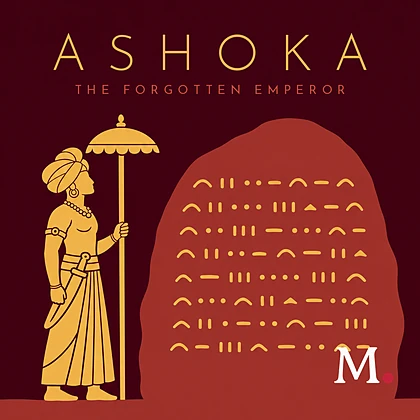
Ashoka: The Forgotten Emperor
Listen in the appIncluded with a Mythio subscription. Try it free for 7 days.
In the third century B.C., the Indian king Ashoka conquered Kalinga, where by his own count one hundred thousand people were killed, and had his remorse carved into stone across his empire. In time, Indian scripts changed beyond recognition, and his words fell silent. In 1830s Calcutta, the mint official James Prinsep set out to read them, drawing on copies and findings from many hands. But the king had named himself only by his titles, so whose voice were they reading?
Sources
The books, archives and first-hand accounts behind this story
Sources
The books, archives and first-hand accounts behind this story
- The Edicts of King Asoka: An English Rendering (The Wheel Publication No. 386/387)Ven. S. Dhammika, Buddhist Publication Society, Kandy, Sri Lanka, 1993
- Inscriptions of Asoka, New Edition (Corpus Inscriptionum Indicarum, Vol. I)E. Hultzsch, Clarendon Press, Oxford, for the Government of India (Internet Archive full text), 1925
- Further elucidation of the lat or Silasthambha inscriptions from various sourcesJames Prinsep, Journal of the Asiatic Society of Bengal, Vol. 6, issue 69, pp. 790 to 797 (BioStor scan, Internet Archive item biostor-280242), 1837
- Note on the Facsimiles of Inscriptions from Sanchi near Bhilsa, taken for the Society by Captain Ed. Smith, Engineers; and on the Drawings of the Buddhist Monument presented by Captain W. Murray, at the meeting of the 7th JuneJames Prinsep, Journal of the Asiatic Society of Bengal, Vol. 6, issue 66, pp. 451 to 463 (BioStor scan, Internet Archive item biostor-280225), 1837
- Further notes on the inscriptions on the columns at Delhi, Allahabad, Betiah, &c.George Turnour, Ceylon Civil Service, Journal of the Asiatic Society of Bengal, Vol. 6, issue 72, pp. 1049 to 1064 (BioStor scan, Internet Archive item biostor-280256), 1837
- The Journal of the Asiatic Society of Bengal, Vol. VII, January to December 1838 (Preface and contents)Asiatic Society of Bengal, Baptist Mission Press, Calcutta (Internet Archive item journalofasiatic773asia), 1838
- Asoka (Gaekwad Lectures)Radhakumud Mookerji, Macmillan and Co., London (PDF hosted by Rare Book Society of India), 1928
- Asoka and the Decline of the MauryasRomila Thapar, Oxford University Press (Digital Library of India scan on Internet Archive), 1961
- The Mahavamsa, or The Great Chronicle of CeylonWilhelm Geiger (translator), assisted by Mabel Haynes Bode, Pali Text Society, Henry Frowde, Oxford University Press (Internet Archive full text), 1912
- The Indian Antiquary, Vol. 18 (April 1889), p. 106 (article on the inscriptions of Piyadasi; author not named on the page)The Indian Antiquary, ed. J. F. Fleet and R. C. Temple, The Indian Antiquary (Jain e-Library page scan), 1889
- Antiochus, King of the YavanasJarl Charpentier, Bulletin of the School of Oriental Studies, vol. 6:2, pp. 303 to 321 (National Taiwan University digital library transcription)
- On the Shoulders of...: Uncovering the Critical Role of Knowledge Diffusion through Peer Influence Network underlying Prinsep's Decipherment of BrahmiSitabhra Sinha and Nandini Mitra, Journal of the Asiatic Society, Vol. LXVI, No. 2 (Special Issue on James Prinsep), pp. 35 to 62, 2024
- James PrinsepEncyclopaedia Britannica (revised by the editors), Encyclopaedia Britannica online
- PRINSEP, James (Persons of Indian Studies)Klaus Karttunen, Persons of Indian Studies (whowaswho-indology.info)
- TURNOUR, George (Persons of Indian Studies)Klaus Karttunen, Persons of Indian Studies (whowaswho-indology.info)
- Prinsep, James (entry in Dictionary of Indian Biography, transcribed by FIBIS)C. E. Buckland; transcription by Families in British India Society, Dictionary of Indian Biography, 1906
- What Hindutva historians could learn from James Prinsep, the Englishman who decoded Ashokan edictsGirish Shahane, Scroll.in, 2018
- Emperor Ashoka's edicts prove that he valued secularism and non-violence above all else (excerpt from A History of Ancient and Early Medieval India)Upinder Singh, Scroll.in, 2024
- Upon This Rock: What the stone edicts of Ashoka tell us about India's great Buddhist rulerNayanjot Lahiri, The Caravan, 2015
- The King and Kalinga: An Excerpt from Ashoka in Ancient IndiaNayanjot Lahiri (book excerpt), The Wire, 2015
- Ashoka Edicts, Jaugada: Confessions of a conquerorSomen Sengupta, The Tribune, 2020
- Journey of a pillarThe Tribune (Spectrum; author not named on the page), The Tribune, 2011
- Review of Ashoka: The Search for India's Lost Emperor (Charles Allen)Reviews in History, Institute of Historical Research (reviewer not shown on the print page), Reviews in History
- Asoka, the Buddhist Emperor of IndiaVincent A. Smith, PDF hosted by buddhadust.net (edition not shown in the text read)
- Political History of Ancient IndiaHemchandra Raychaudhuri, University of Calcutta (Jain e-Library page scan)
- James Prinsep: Decoding Ancient IndiaAkshay Chavan, Live History India, 2019
- Prinsep, JamesBanglapedia (article signed [Abu Imam]), Banglapedia, Asiatic Society of Bangladesh
- Discovery of the name of Antiochus the Great, in two of the edicts of Asoka, king of IndiaJames Prinsep, Journal of the Asiatic Society of Bengal, Vol. 7, issue 74, pp. 156 to 167 (BioStor 280276; BHL part 368078; Internet Archive item biostor-280276), 1838
- Examination of the separate edicts of the Aswastama inscription at Dhauli in Cuttack (Plate X.)James Prinsep, Journal of the Asiatic Society of Bengal, Vol. 7, issue 77, pp. 434 to 456 (BioStor 280297; BHL part 368096; Internet Archive item biostor-280297), 1838



Where can I listen?
Start listening
Every Original is in the Mythio app, on iPhone and Android.